
News & Insights
AI Chatbot For Ecommerce: How to Choose, Launch and Scale in 2026
On Digitals
03/07/2026
30
An AI chatbot for an ecommerce website helps shoppers discover products and reach support without leaving the store. The right solution combines accurate product data, clear business rules, live-system access where needed, human handoff, and reporting that measures successful resolution rather than chat volume alone.
Quick answer
Choose an ecommerce chatbot based on the job it must do. This means product-discovery assistants suit stores with complex catalogues, while support agents suit brands handling frequent order, shipping, and return questions.
Social-commerce bots suit brands selling through WhatsApp or Instagram. A custom build becomes more relevant when your chatbot needs proprietary product logic, authenticated data, strict permissions, or a branded buying journey.
Key Takeaways
- Best for Shopify-first support: Gorgias
- Best for established support teams: Intercom Fin or Zendesk AI
- Best for smaller website support teams: Tidio Lyro
- Best for social-commerce messaging: Chatfuel
- Best for complex proprietary workflows: A custom grounded chatbot
What is an AI chatbot for ecommerce?
An AI chatbot for ecommerce is a conversational assistant that helps customers purchase and get support through a messaging channel.
It can answer questions about everything related to products, services and policy. More advanced versions can retrieve live information or trigger approved actions through connected systems.
In fact, not every ecommerce chatbot works in the same way. A simple rule-based bot follows a scripted decision tree. It can route people to a return-policy page or ask which order issue they have. While a conversational AI chatbot can understand broader natural-language questions, and a RAG chatbot can retrieve available information before answering.
An AI agent goes one step further by updating an account detail or initiating an approved workflow. That makes it more useful, but also raises the standard for testing and human oversight.
How AI ecommerce chatbots work
A good AI chatbot for ecommerce shouldn’t answer from general model memory alone. For further efficiency, it should retrieve current store information, apply business rules, and link shoppers to the relevant product or support page.
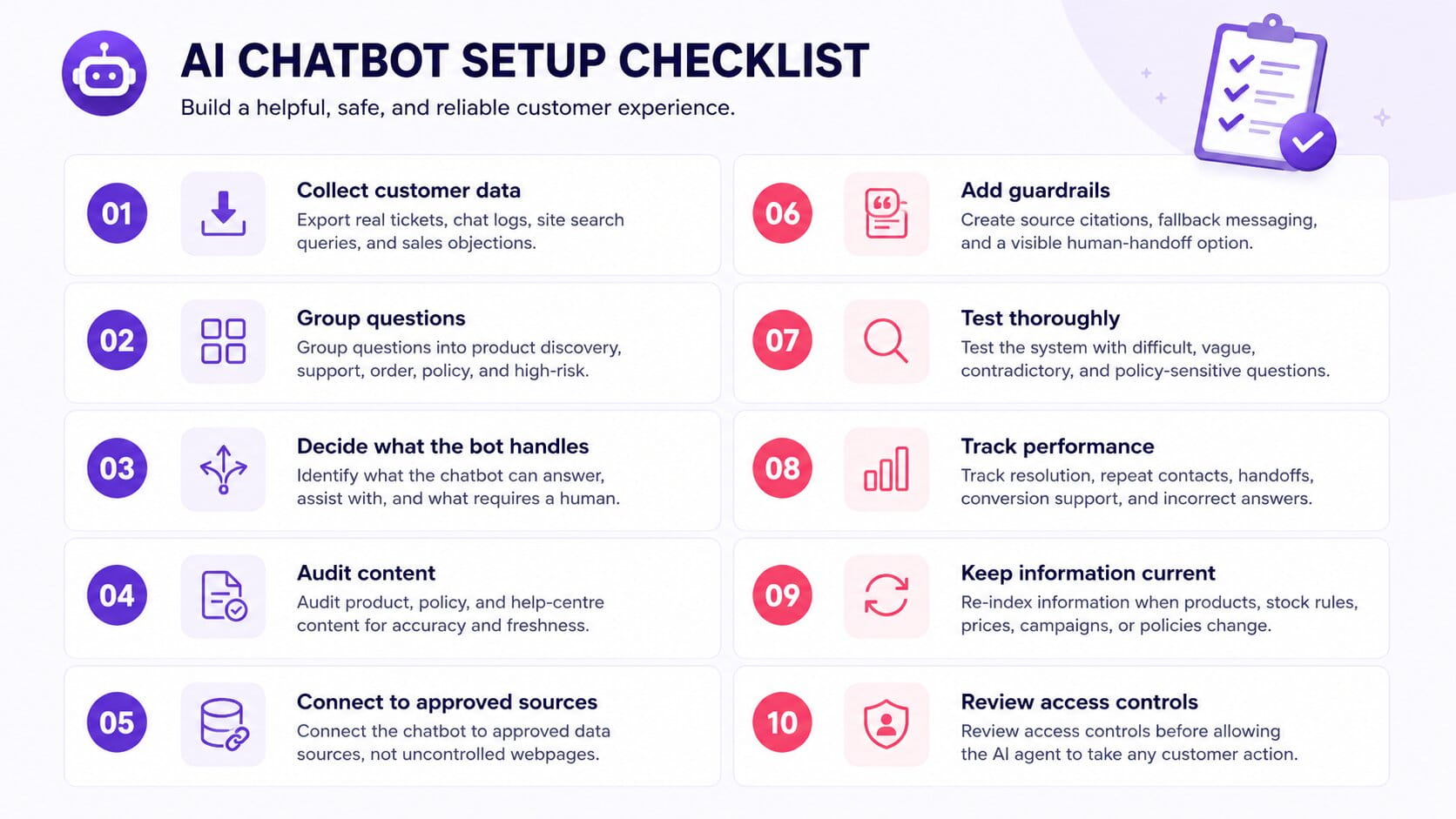
This is where a RAG chatbot becomes useful. Retrieval-augmented generation gives the model relevant product and policy information at the time of the query. Hence, this way is more reliable than asking a general model to remember every detail.
Moreover, a chatbot should also know when it doesn’t have enough evidence. “I could not confirm that from the current product information” is better than inventing a compatibility answer or delivery commitment.
Best AI Chatbot Tools for Ecommerce Websites in 2026
No tool is best for every ecommerce business. A Shopify brand with heavy order volume has different needs from a social-commerce brand, an enterprise retailer, or a store with specialised products and custom account logic. The comparison below groups platforms by their strongest use case rather than presenting a universal ranking.
| Tool or approach | Best fit | Main strength | Main limitation | Pricing model to inspect |
| Gorgias AI Agent | Shopify and DTC support teams | Ecommerce support, order workflows, shopping assistance | Strongest when your support stack fits Gorgias | Per resolved interaction plus help-desk costs |
| Intercom Fin | Mature support and SaaS-style ecommerce teams | AI support, human handoff, multi-channel workflows | Usage pricing can grow with successful outcomes | Per outcome plus seats |
| Tidio Lyro | Smaller ecommerce support teams | Fast setup, website support, product and FAQ assistance | Less suitable for highly custom workflows | Subscription plus AI conversation usage |
| Zendesk AI | Existing Zendesk users | Enterprise ticketing, service operations, reporting | Best fit when Zendesk is already central | Agent-seat and suite pricing |
| Kayako | High-volume ecommerce support | Order status, returns, shipping, support workflow | More support-oriented than discovery-oriented | Enterprise or custom pricing |
| Delight.ai | Enterprise omnichannel ecommerce | AI agents across web, mobile, messaging, and support channels | Usually requires a larger implementation budget | Quote-based enterprise pricing |
| Chatfuel | Social-commerce brands | Instagram, WhatsApp, Facebook, TikTok automation | Not a replacement for full website support | Channel and conversation-based pricing |
| Custom RAG chatbot | Complex product logic or private systems | Data ownership, custom UX, bespoke workflows | Requires engineering and maintenance | Build, infrastructure, usage, and support costs |
Gorgias AI Agent
Gorgias is suited to ecommerce brands that treat support as part of the sales journey. Its AI Agent is designed around ecommerce workflows such as:
- order tracking
- returns
- FAQs
- live inventory
- product recommendations
- support handoff
Gorgias states that its pricing is based mainly on resolved interactions rather than message volume, with most plans priced at around US$0.90 per resolved interaction.
Gorgias is most relevant for Shopify-first and direct-to-consumer brands with substantial order and seasonal support demand. However, it may be less suitable when the business needs deep custom applications, complex authenticated workflows, or a highly bespoke customer interface.
Intercom Fin
Intercom Fin is designed for companies that need AI support across website chat and other service channels. It now includes ecommerce-specific positioning around browsing, product guidance, and checkout support.
Intercom lists Fin at US$0.99 per outcome, while platform plans may also include seat-based fees.
Intercom is a stronger fit for businesses with:
- an established support function
- a large knowledge base
- a need for human agents to work alongside AI
It is less attractive for teams that only need a low-cost FAQ widget on a small storefront.
Tidio Lyro
Tidio Lyro is a practical option for smaller ecommerce and service teams that want website chat and basic AI support without committing immediately to an enterprise service stack. Tidio positions Lyro around helping customers:
- find products
- compare variants
- understand product details
- receive support using synced store information
It is most useful when fast implementation matters and the store has relatively clear information, rules and support processes. However, businesses with complex permissions, proprietary systems, or unusual product logic may outgrow a standard configuration.
Zendesk AI
Zendesk AI is usually strongest for businesses that already operate support through Zendesk. Its AI agents are positioned around resolving requests across messaging and email, while keeping analytics and human support in the same operational environment.
Zendesk’s public plans begin from US$19 per agent each month for basic support, while AI features and advanced service capabilities depend on the selected suite and configuration.
Choose Zendesk AI when your business already has:
- customer service operations
- SLA management
- multilingual support
- reporting
- large-scale ticket handling
It’s not necessarily the simplest answer for a smaller store that only needs product discovery and basic FAQ automation.
Kayako
Kayako focuses heavily on:
- ecommerce support automation
- especially order status
- returns
- shipping delays
- FAQs
Its current ecommerce content positions the product as an AI-first support platform for high-volume retailers that need more than a generic website chatbot.
Kayako is most relevant when post-purchase service is the main problem. A brand that needs rich guided selling or deeply personalised recommendations should evaluate whether Kayako’s support-first orientation matches the shopping journey it wants to improve.
Delight.ai
Delight.ai, previously associated with Sendbird’s customer-experience platform, positions itself around omnichannel AI agents for larger ecommerce organisations. Its ecommerce, together with AI-led handling of more complex workflows, material emphasises:
- Website
- Mobile
- Messaging
- CRM
- Product-catalogue
- Support-policy connection
It is likely to fit enterprise brands that need communications across channels and support software. Pricing is generally quote-based, so buyers should model implementation cost, security review, and ongoing optimisation rather than comparing it only with self-serve chatbot plans.
Chatfuel
Chatfuel is built more for social commerce than traditional website support. It automates conversations across Instagram, WhatsApp, Facebook, and TikTok, making it useful for brands that generate demand through social ads, content, and direct messages.
It is a strong option when the buying conversation begins on social channels. However, it’s not a full substitute for a website chatbot or customer-account assistant when shoppers need detailed product data and ongoing support across channels.
Custom RAG Chatbot
A custom RAG chatbot is a tailored system that retrieves from your own data and internal ìnormation. It is useful when standard tools cannot model your product logic or unique buying journey.
The trade-off is responsibility. A custom build requires source-data governance, backend integration, security controls and maintenance. It’s not the fastest route for a simple FAQ widget, but it can be the right route when the chatbot becomes part of core ecommerce infrastructure.
What Can an Ecommerce AI Chatbot Do Across the Shopping Journey?
An ecommerce chatbot should reduce friction at the point where a shopper needs an answer to continue.
The strongest use cases are usually specific: product discovery before purchase, delivery or return questions after purchase, and fast handoff when the customer needs a person rather than another automated answer.
| Shopping stage | Typical customer question | Useful chatbot role | Human handoff trigger |
| Product discovery | Which option suits my needs? | Guided recommendation | Complex preference or high-value purchase |
| Product comparison | What is the difference between these? | Explain attributes, variants, fit, compatibility | Incomplete or uncertain product data |
| Cart and checkout | Can I use this discount? | Explain valid offers and shipping rules | Payment or discount exception |
| Delivery and tracking | Where is my order? | Retrieve approved tracking information | Delivery dispute or failed lookup |
| Returns and exchanges | Can I return this item? | Explain policy and start a request | Exception, damaged order, refund dispute |
| Post-purchase support | How do I use this product? | Product-care guidance and troubleshooting | Safety, warranty, or technical issue |
| Lead capture | Can someone help me choose? | Qualify and route enquiries | High-intent or enterprise buyer |
The commercial value isn’t simply answering questions faster. It’s helping shoppers move from uncertainty to the next correct action.
How Do You Choose the Right Ecommerce Chatbot?
The right ecommerce chatbot depends on the business problem, not the size of the vendor’s feature list. Start by identifying where customers get stuck most often, then choose a system that can access the right data, take only approved actions, and hand difficult cases to the right person.
| Decision factor | Question to ask |
| Support volume | Which questions create the most tickets? |
| Store platform | Are you on Shopify, WooCommerce, Adobe Commerce, or a headless stack? |
| Catalogue complexity | Does the chatbot need variants, bundles, fit, compatibility, or subscriptions? |
| Data access | Does it need only public content or private order and account data? |
| Channels | Website only, or also WhatsApp, Instagram, email, and mobile app? |
| Customer journey | Is the priority product discovery, support, post-purchase care, or social selling? |
| Human handoff | Can staff receive chat history, source links, and customer context? |
| Compliance | Are there payment, medical, privacy, financial, or regional-policy constraints? |
| Measurement | Will you track resolution, repeat contacts, conversion support, and errors? |
What Does an Ecommerce AI Chatbot Really Cost at Scale?
The starting price is rarely the real cost. Ecommerce chatbot pricing may be based on support seats, conversations, messages, active contacts, AI outcomes, resolved interactions, or enterprise contracts. A tool that looks inexpensive at low volume can become materially more expensive when the chatbot starts handling thousands of meaningful customer requests.
| Cost area | What it includes | Why it matters |
| Base platform | Help desk, inbox, widget, workflow features | Entry pricing often excludes advanced automation |
| AI usage | Messages, outcomes, resolutions, conversations | Costs usually rise with adoption |
| Integration work | Shopify, CRM, help desk, catalogue, order system | May require higher-tier plans or development |
| Knowledge preparation | Product data, FAQs, policies, returns, shipping rules | Weak content creates weak answers |
| Internal operations | Quality review, escalation, support ownership | Required for long-term accuracy |
| Custom development | UX, RAG, API, security, permissions, analytics | Needed for complex workflows |
For example, Gorgias says many plans price AI resolutions at around US$0.90 per resolved interaction. At 1,000 resolved interactions, that is roughly US$900 before other help-desk costs. At 5,000 resolved interactions, it is roughly US$4,500.
Intercom’s US$0.99 Fin outcome model would equate to around US$990 for 1,000 outcomes or US$4,950 for 5,000 outcomes, before seats or other platform charges.
These examples don’t mean usage pricing is bad. A chatbot that resolves repetitive work accurately can still create value. However, ecommerce teams should forecast cost at three levels:
- pilot traffic
- current support volume
- peak seasonal volume
Agentic commerce
Ecommerce now has two important AI surfaces.
The first is your own on-site chatbot. The second is the growing set of external AI systems that can discover products and increasingly support transaction flows outside your website.
OpenAI’s Agentic Commerce Protocol, or ACP, is designed to connect merchants and ChatGPT through structured catalogue data and commerce workflows.
OpenAI’s current documentation explains that, through their own commerce stack, merchants still retain control over:
- order acceptance
- payment processing
- fulfillment
- customer support
Also, Google is building in a similar direction through its Universal Commerce Protocol, or UCP. Google states that UCP can connect eligible merchants to AI Mode in Search and Gemini web, while merchants remain the merchant of record and retain customer relationships.
This changes how ecommerce teams should think about chatbot work. Your store now should be easy for AI systems to understand.
In other words, the structure of the website must be clear and easy to follow. A conversational shopping agent cannot confidently recommend a product if the store’s information is incomplete or split across disconnected pages.
Early research on agentic ecommerce also suggests that AI shoppers don’t behave exactly like others.
A Columbia University study in 2025 found that AI agents showed strong but varied preferences for product position, sponsored labels, endorsements, price, ratings, and reviews. Different models didn’t consistently favour the same best placement.
This is preliminary, unpeer-reviewed research, but it supports the practical conclusion that product information needs to be optimized to ensure clarity and integrity, rather than relying solely on a single AI ranking tactic.
Accuracy is a liability – What the Air Canada case means for your store
An ecommerce chatbot is part of your customer-facing experience. If it states the wrong information, the business may still be responsible for what the shopper relied on.
The Air Canada case is a useful warning. In Moffatt v. Air Canada, a chatbot gave a customer incorrect advice about a bereavement fare policy.
The British Columbia Civil Resolution Tribunal found Air Canada liable for negligent misrepresentation and rejected the airline’s attempt to treat the chatbot as separate from the company. The award totalled CAD 812.02, including damages, interest, and tribunal fees.
This does mean ecommerce teams should treat chatbot answers as publishable business communication, not experimental copy.

A safer implementation includes:
- Grounding answers in approved catalogue and policy data
- Showing source links for important claims
- Blocking unsupported price, stock, and policy promises
- Adding clear conditions around promotions and delivery
- Logging answers, sources, and action requests
- Escalating refunds, cancellations, disputes, and exceptions
- Re-indexing content when policies or products change
A disclaimer alone doesn’t fix a chatbot that confidently gives incorrect commercial information.
Designing a chatbot that actually sells
A chatbot doesn’t need to pretend to be human to be useful. However, its tone and clarity can affect whether shoppers trust it enough to continue.
A 2021 meta-analysis by Blut, Wang, Wünderlich, and Brock found that anthropomorphism can influence customer intentions to use chatbots and other AI. The paper also found that effects depend on context and are shaped by perceived intelligence and usefulness, rather than human-like styling alone.
More recent ecommerce-specific evidence is more nuanced.
A 2026 field experiment on a Japanese cosmetics retailer found that a less human-like, cartoon-style chatbot combined with warm responses improved subscription purchases, while competence-oriented responses worked better for one-time purchasers.
The findings suggest that warmth and customer relationship can matter more than simply making a bot look like a person.
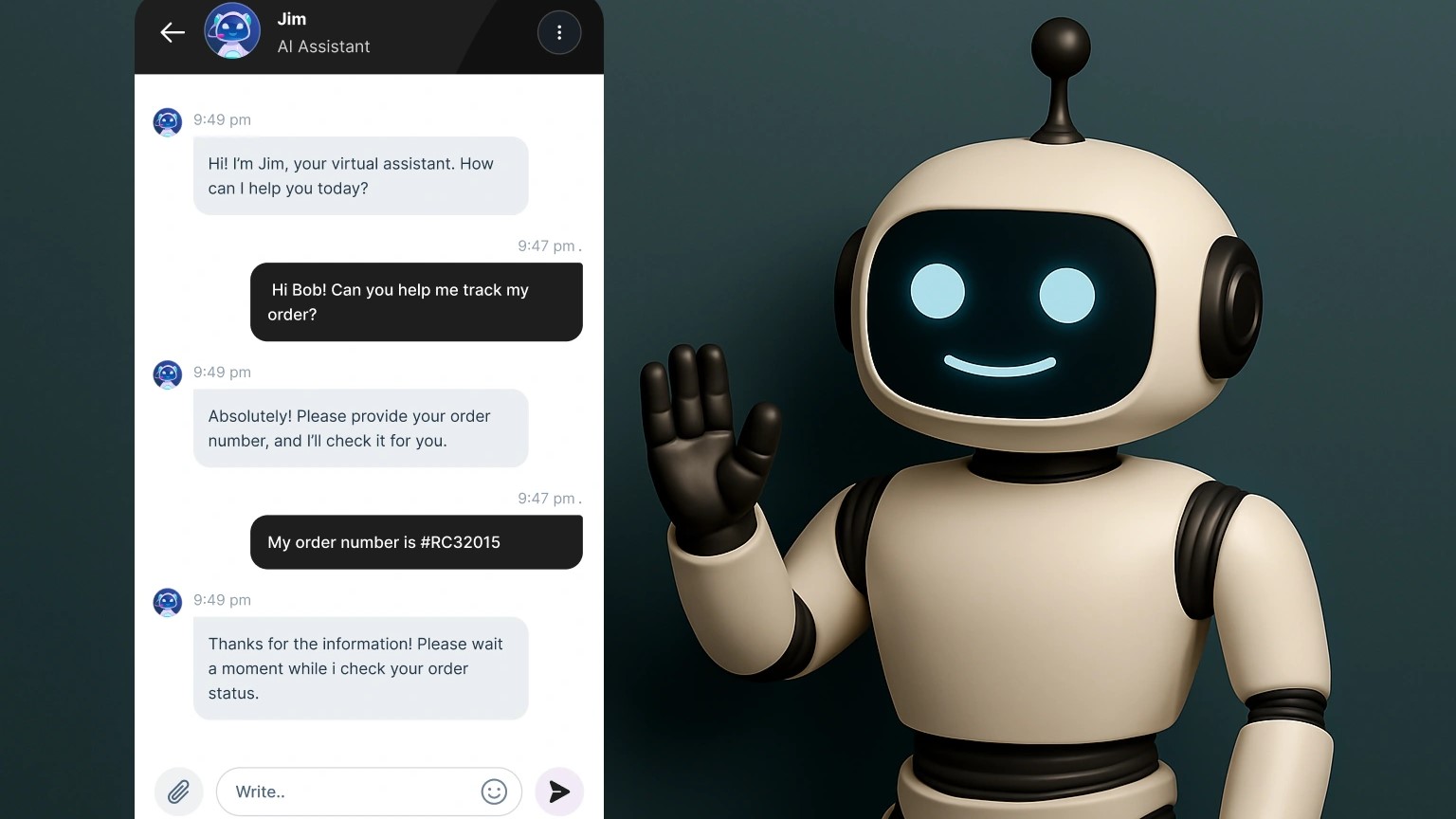
This gives ecommerce teams a better design rule:
- Use clear competence for product comparison, compatibility, price, and delivery questions.
- Use warmth and reassurance for post-purchase care, onboarding, and recurring customer relationships.
- Avoid over-humanising the interface when it makes the bot feel deceptive, vague, or overly familiar.
- Test the conversation against real commercial outcomes, not only click-through rate.
The strongest chatbot personality is the one that feels honest, specific, and appropriate for the customer’s task.
Getting recommended by AI
Traditional ecommerce discovery relied on search bars and product detail pages. Conversational discovery adds a new layer – shoppers can ask for a solution in natural language rather than navigate a catalogue manually.
Instead of searching for “running shoes”, a customer may ask, “Which shoe is suitable for short runs and wet weather under this budget?”
Your on-site chatbot, ChatGPT, Gemini, or another assistant needs structured and credible information to answer that question well.
Product content should therefore include:
- Accurate product names and variants
- Clear attribute data
- Compatibility and fit information
- Current price and availability
- Product-specific FAQs
- Shipping and return conditions
- Reliable reviews and proof where available
- Comparison content for meaningful alternatives
This is where digital content, technical SEO, structured data, and chatbot design meet. Better product information helps search engines understand the information, helps people make decisions, and gives AI systems evidence to recommend the right ones.
Build vs buy an ecommerce chatbot
Buying a platform is often the fastest route when the business needs standard support automation. Meanwhile, building a custom one makes more sense when your product logic or customer journey are not standard.
| Option | Best for | Main trade-off |
| No-code chatbot | Small stores with simple FAQs and lead capture | Limited control over complex product logic |
| Support-suite AI agent | Teams already using a help desk | May be less flexible outside its ecosystem |
| Ecommerce-focused chatbot | Stores needing catalogue and order integrations | Features can be tied to a vendor roadmap |
| Custom RAG chatbot | Complex catalogues, unique workflows, branded UX | Requires engineering, monitoring, and content governance |
| Action-taking AI agent | Well-defined, permissioned customer tasks | Highest risk and strongest governance requirement |
There is no universal best ecommerce chatbot. The right choice depends on your store needs.
A custom build is worth considering when the chatbot must understand proprietary product rules, integrate with Shopify or WooCommerce data, and hand conversations to human agents with complete context.
Ecommerce chatbot implementation checklist
Before launching, check whether the chatbot can answer the questions customers actually ask and whether it has a safe path when it cannot.
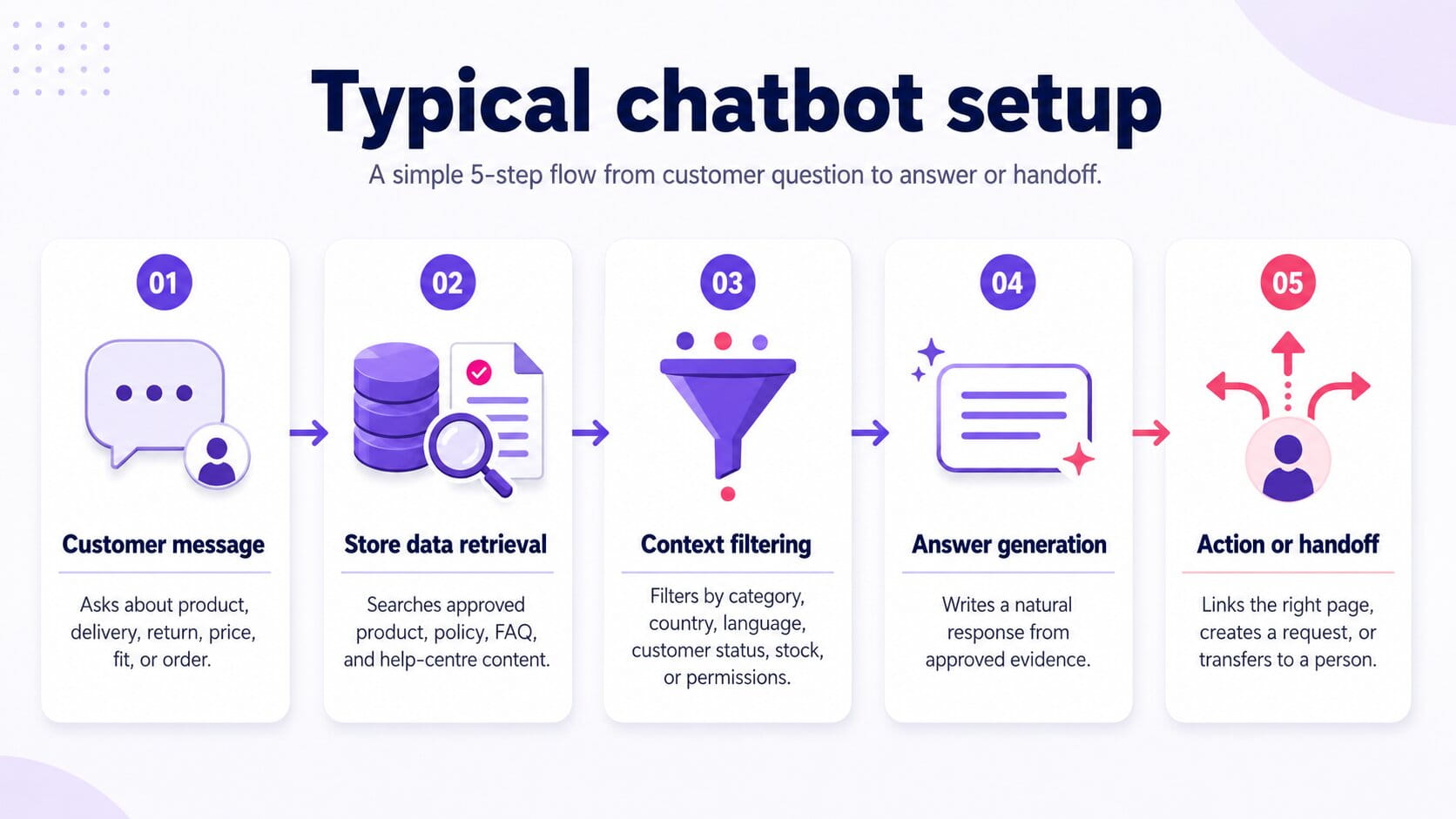
The first version should focus on a narrow, high-volume problem. A chatbot that accurately answers shipping, returns, product fit, and order-status questions is more valuable than a broad assistant that tries to handle every customer need from day one.
Frequently asked questions (FAQs)
What is the best AI chatbot for an ecommerce website?
The best ecommerce chatbot depends on your business model. Gorgias is often relevant for Shopify and DTC support. Intercom Fin and Zendesk AI suit larger support operations. Tidio Lyro can suit smaller website support teams. Chatfuel is more relevant for social commerce. A custom RAG chatbot is stronger when product logic, data permissions, or workflows are not standard.
Can an AI chatbot recommend products?
Yes. An AI chatbot can recommend products when it has accurate access to product attributes, categories, variants, compatibility rules, price ranges, stock status, and customer preferences. It should explain why a product fits the stated need and offer a human handoff when the purchase is complex, high-value, or sensitive.
Can an ecommerce chatbot access Shopify order information?
It can, but only when the chosen tool or custom integration connects securely to Shopify data and applies the correct permissions. The chatbot should verify customer identity before exposing private order information. It should also avoid allowing unrestricted changes to refunds, addresses, cancellations, or payment details without confirmation and approval.
How much does an ecommerce AI chatbot cost?
Costs may include a base platform subscription, support seats, AI outcomes, messages, conversations, ecommerce integrations, knowledge-base work, custom development, and ongoing monitoring. A small pilot may be affordable, while a high-volume support operation can incur substantial usage charges. Forecast costs at expected seasonal volume, not only at the entry-plan limit.
Should an ecommerce chatbot replace live chat agents?
No. Ecommerce chatbots are strongest for repeatable questions, product discovery, policy guidance, order tracking, and basic support. Human agents remain important for disputes, exceptions, high-value sales, emotional complaints, complex technical questions, and situations where the chatbot lacks sufficient confidence or access to resolve the issue.
Is a custom ecommerce chatbot better than a no-code tool?
A custom chatbot is better only when standard tools cannot meet the business requirement. It becomes valuable when you need proprietary product logic, multiple data sources, authenticated customer experiences, unique workflows, detailed permissions, custom analytics, or a branded customer journey. For common FAQs and basic support, a no-code platform may be faster and more cost-efficient.
How do I keep ecommerce chatbot answers accurate and safe?
Use approved product and policy sources, keep data current, add retrieval rules, show source links where appropriate, prevent unsupported promises, and escalate uncertain answers. For security, limit data access, keep high-risk actions behind approval flows, test prompt injection, and review conversations that fail or require repeated handoff.
NEWEST POSTS
- AI Chatbot For Ecommerce: How to Choose, Launch and Scale in 2026
- Best AI Chatbot For Websites: 8 Tools Compared & When To Build Custom
- AI Chatbot Development: Process, Cost & What Actually Ships
- Chatbot vs Live Chat: Which Is Right for Your Business?
- How to Build And Integrate A RAG Chatbot Into Your Website
Read more
Tell us about your business challenge and get a tailored consultation today.