
News & Insights
Chatbot vs Live Chat: Which Is Right for Your Business?
On Digitals
01/07/2026
40
Chatbot vs live chat is no longer a simple automation-versus-human decision. Modern businesses can use from rule-based bots, AI copilots for agents, to hybrid handoffs that complete approved actions. The suitable model depends on issue complexity and how quickly a human can take over.
Quick verdict
Businesses can think of a chatbot when it comes to repeatable questions and high-volume requests with clear answers. Otherwise, live chat would be fixed for sensitive or high-value conversations.
In most cases, the best option is hybrid. AI, hence, handles routine work, while humans handle complex issues with the conversation context intact.
Key takeaways
- A chatbot is strongest when the knowledge base and escalation rules are strong.
- Live chat isn’t purely manual anymore; AI can help agents write and resolve faster.
- The goal is to complete resolution with minimal customer effort.
What is a chatbot?
A chatbot is software that communicates with users through text or voice. It can follow fixed rules, use natural language processing, or use an LLM to generate responses.
The word “chatbot” covers very different systems, so businesses should define the type before comparing it with live chat.
Rule-based chatbot
This type of chatbot follows pre-set decision trees. It works well for stable tasks, such as:
- sending visitors to a shipping-policy page
- collecting a lead form
- checking basic eligibility
- routing an enquiry to the correct team
AI or LLM chatbot
These ones understand more natural language and can answer a broader range of questions. A well-built version often uses retrieval-augmented generation, or RAG, to answer from your website and policies rather than relying only on a general model.
AI agent
AI agents go further by retrieving information and completing permitted actions through connected systems.
For example, it may update an address, cancel a subscription, or start a refund workflow. That extra capability also creates more controlling and testing requirements.
What is live chat?
Live chat is a real-time conversation between a customer and a human agent through a messaging platform. It is most valuable when the customer needs context or a solution that doesn’t fit a standard workflow.
The old comparison assumed live chat meant one person manually answering every message and that’s no longer accurate.
Human agents increasingly work with AI copilots that suggest responses and highlight relevant information.
This matters because live chat can now be both human-led and AI-augmented. The customer still reaches a person, but that person may resolve the issue more consistently and with less time spent searching through documentation.
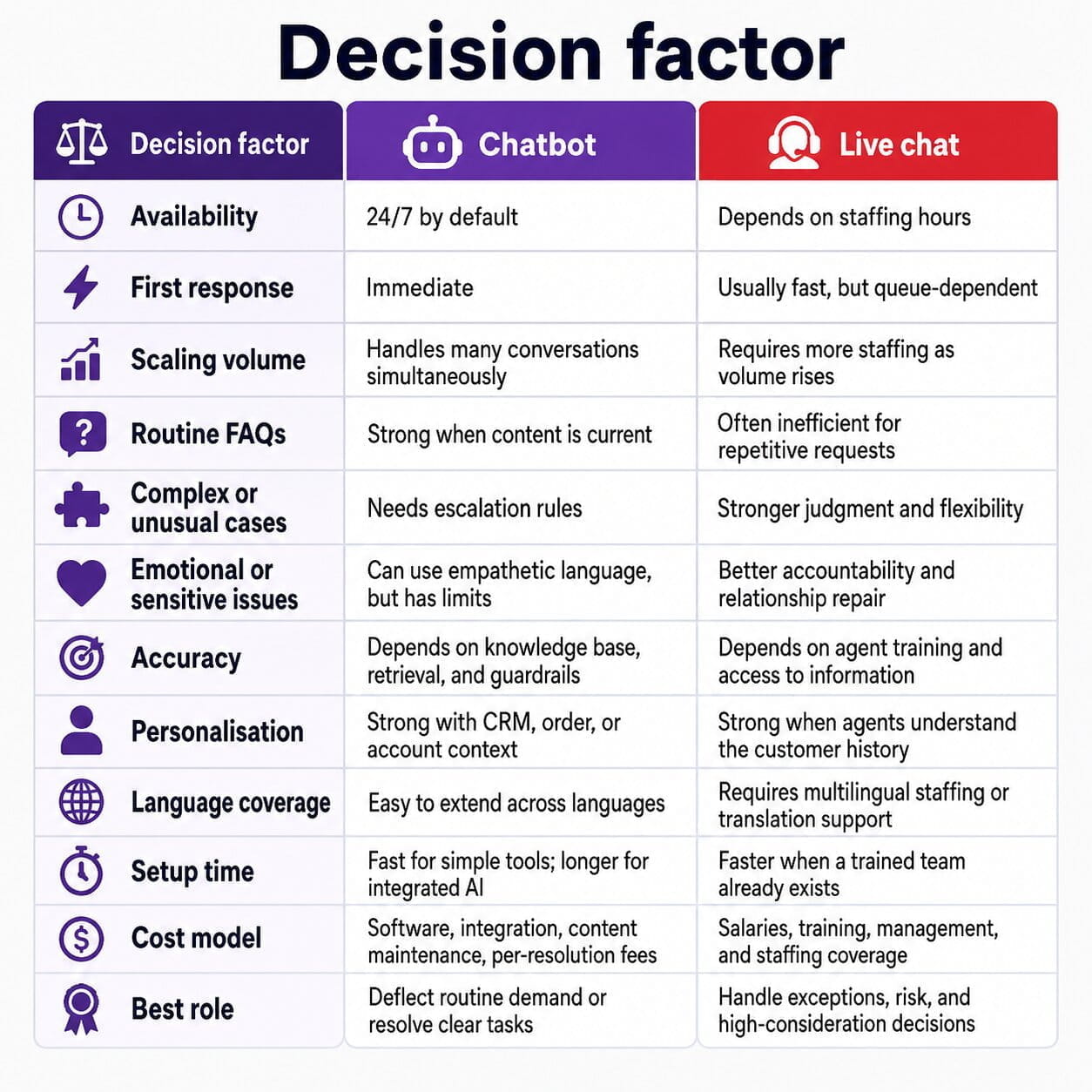
Pros and cons of chatbots
Chatbots create the most value when customers ask similar questions repeatedly. They reduce waiting time, keep support available outside business hours, and give teams a consistent way to present approved answers.
Main advantages
- Immediate response for common questions
- Scales without adding one agent per conversation
- Collects structured data on demand, intent, and content gaps
- Can route customers before an agent spends time on triage
- Supports multilingual service more efficiently
The main limitation is that chatbot can fail when knowledge is incomplete and the task requires access to systems and exceptions. A polished answer is still a poor customer experience if it is wrong or doesn’t move the issue forward.
Main risks
- Outdated or incomplete knowledge produces wrong answers
- Rigid conversation flows frustrate customers
- Weak escalation creates dead ends
- Poorly governed AI can expose policy, privacy, or brand risk
- A high deflection rate can hide unresolved customer problems
Pros and cons of live chat
Live chat gives customers access to human judgment at the moment they need it. It is particularly useful for high-value sales, regulated services, technical troubleshooting, and situations where a customer needs reassurance before committing.
Main advantages
- Handles ambiguity, exceptions, and negotiation
- Supports trust in emotional or high-stakes situations
- Lets agents recognise context that may not exist in the knowledge base
- Can recover difficult conversations before they become churn or complaints
- Creates qualitative insight that helps improve products and policies
However, human support is expensive to scale and can be inconsistent without good training and workflow support. Customers also don’t want to wait for a person when the answer is a simple delivery update or password-reset instruction.
Main limitations
- Limited availability without round-the-clock staffing
- Response speed can fall during peak demand
- Training gaps create inconsistent answers
- Repetitive queries consume skilled agent time
- Cost rises with volume, staffing, and coverage requirements
The real choice isn’t binary
Instead of thinking solutions should be “all chatbot” or “all human”, dealing with customer risk and issue complexity as final objectives is more useful.
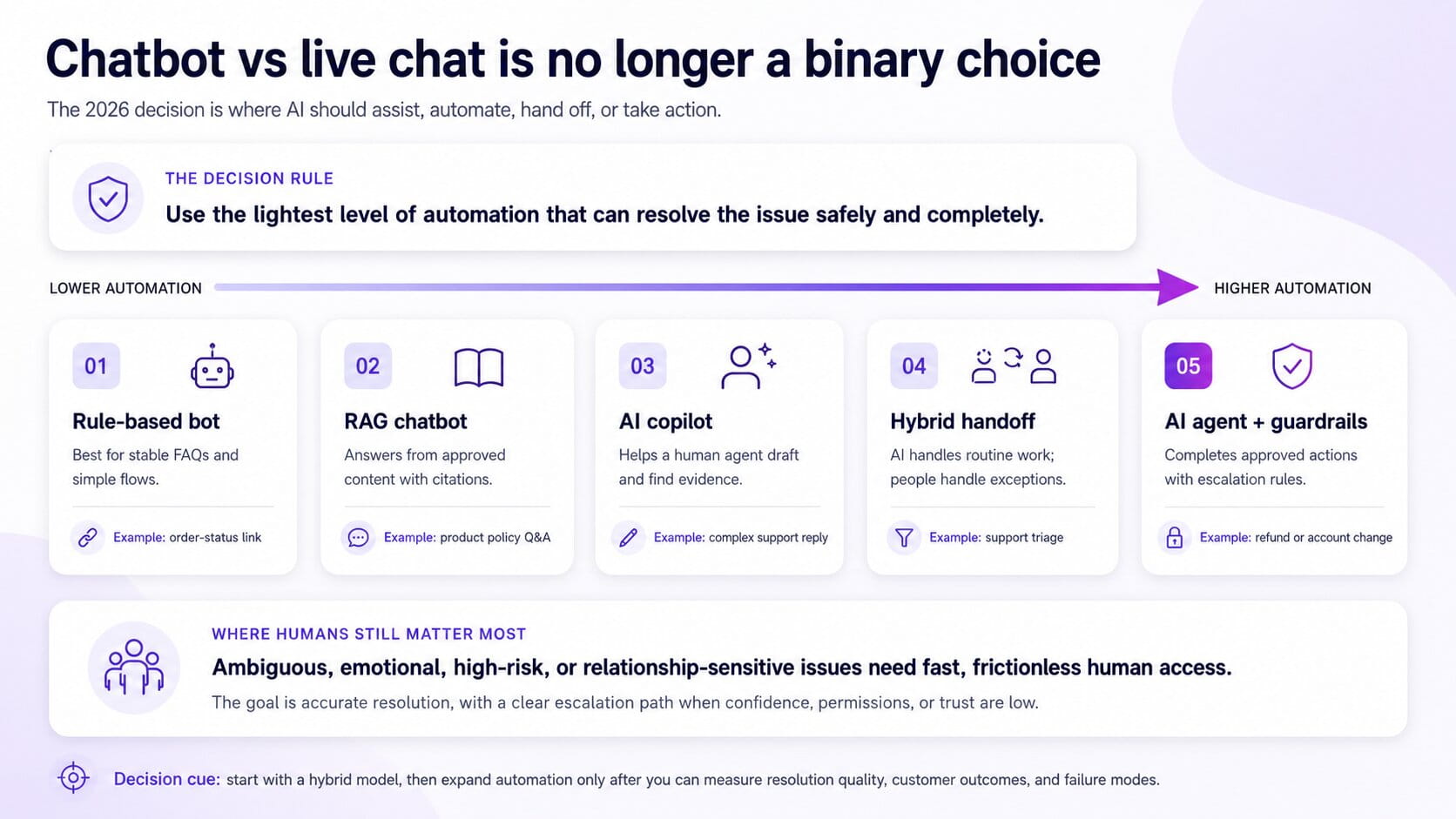
At one end, a rule-based bot handles simple journeys. Next, a RAG chatbot answers from approved website content and product information. Then comes the AI copilot, where a human agent stays in control but receives faster access to knowledge and response support.
For many businesses, the strongest default is a hybrid handoff model
AI answers routine questions and passes the full conversation to an agent when confidence is low or the customer needs judgment. At the far end, an AI agent completes specific actions, but only within strict permissions and escalation rules.
Research supports this middle-ground approach.
Brynjolfsson, Li, and Raymond studied 5,172 customer-support agents using a conversational AI assistant. The final Quarterly Journal of Economics version found a 15% average productivity increase, while lower-skilled and less-experienced agents improved by about 30%. The research also found faster learning, more polite customer behaviour, fewer requests to speak to a manager, and lower attrition among newer workers.
The earlier working-paper version reported 14% average productivity growth and a 34% gain for novice and lower-skilled agents. The difference reflects the published-paper update, so the final figures are safer to use in the article.
AI doesn’t have to replace live chat to improve it. It can raise the consistency of less-experienced agents and help teams reserve human attention for issues that actually need it.
Does live chat really win on empathy? What the research says
Businesses often assume human agents automatically provide more empathy than chatbots. Research suggests the situation is more complicated in text-based conversations.
Ayers and colleagues compared physician responses with ChatGPT responses to 195 patient questions from a public online forum.
Licensed healthcare professionals preferred chatbot responses in 78.6% of evaluations. Responses from the chatbot were also rated 3.6 times more likely to be good or very good in quality, while empathetic or very empathetic ratings were 9.8 times more common.
A 2025 replication with 1,454 online participants found that chatbot responses were again rated as more empathetic than physician responses. The chatbot responses included more validation, non-judgmental language, and structured follow-up.
This does not prove that an AI chatbot can replace a skilled human in a difficult live support conversation. These studies involved asynchronous medical Q&A, not high-pressure customer service or relationship repair.
The chatbot responses were also substantially longer than physician responses in the original study.
Still, the research challenges a lazy assumption – empathy in text chat is partly a communication-design problem.
Clear acknowledgement, calm language, useful explanation, and a respectful next step can be systematised. AI can help agents apply those behaviours more consistently, while humans remain essential when the situation needs real-world action.
Should you tell customers they are talking to a bot?
Of course. Transparency should be part of the interface and service design, even though disclosure can affect customer behaviour.
A 2019 field experiment by Luo, Tong, Fang, and Qu studied more than 6,200 customers receiving highly structured outbound sales calls. Undisclosed chatbots performed as well as proficient human workers and four times better than inexperienced workers at generating purchases.
However, disclosing the chatbot identity before the conversation reduced purchase rates by more than 79.7%. Participants perceived the disclosed bot as less knowledgeable and less empathetic, despite no change in its underlying capability.
This is the disclosure paradox. Customers may prefer transparency in principle, yet their expectations can shift once they know they are speaking with AI. That doesn’t justify concealing the system, but means disclosure should be designed well instead.
A better approach is simple and useful:
- State clearly that the customer is chatting with an AI assistant.
- Explain what it can help with.
- Explain when it will transfer to a person.
- Make human escalation easy to find.
- Avoid pretending that automated messages come from a named employee.
For businesses serving EU users, Article 50 of the EU AI Act requires people interacting directly with AI to be informed that they are interacting with an AI system unless that is obvious from the context.
The transparency obligations are scheduled to apply from 2 August 2026, so businesses should treat disclosure as a product and compliance requirement rather than a small legal footer.
AI agents – The hype-versus-reality gap
AI agents are moving beyond FAQ answers. They can connect to help CRM systems, ecommerce platforms, billing tools, and account databases to complete approved actions. This can include checking a delivery, verifying an account, or initiating a refund.
Vendor-reported results can look very high. Intercom states that Fin averages a 76% resolution rate across more than 12,000 customers, while Decagon says well-defined AI-agent use cases can achieve 60% to 80% ticket deflection. These are useful signals of what is possible in selected environments, but they are vendor metrics, not universal benchmarks.
The broader reality is more cautious. Gartner’s survey of 5,728 customers found that only 14% of customer-service issues were fully resolved in self-service. Even among issues customers considered very simple, only 36% were fully resolved. The most common failure wasn’t finding relevant content.
These numbers shouldn’t be compared as if they measure exactly the same thing. Vendor resolution, chatbot containment, and customer-reported full self-service resolution use different definitions. That is precisely why businesses shouldn’t choose a platform based only on a headline percentage.
Firms should measure whether the customer’s issue was actually resolved by tracking relevant metrics like repeat contacts, incorrect answers, etc.
When to use a chatbot vs live chat vs hybrid vs AI agent
Use a chatbot when the issue is repeatable and low-risk. Typical examples include:
- opening hours
- shipping policies
- service eligibility
- product specifications
- order tracking
- basic lead qualification
Use live chat when the customer has a complaint or request that needs human judgment. Human agents should also be easy to reach when a customer is frustrated or repeatedly asks for help.
Use a hybrid model when customer demand includes both routine and complex conversations. The chatbot can answer simple questions and then pass the conversation to an agent. The human should receive the customer’s message history and relevant source pages.
Use an AI agent when the task is well-defined and measurable. Companies can start with low-risk workflows such as:
- checking delivery status
- resetting access
- updating non-sensitive details
- issuing a policy-based credit
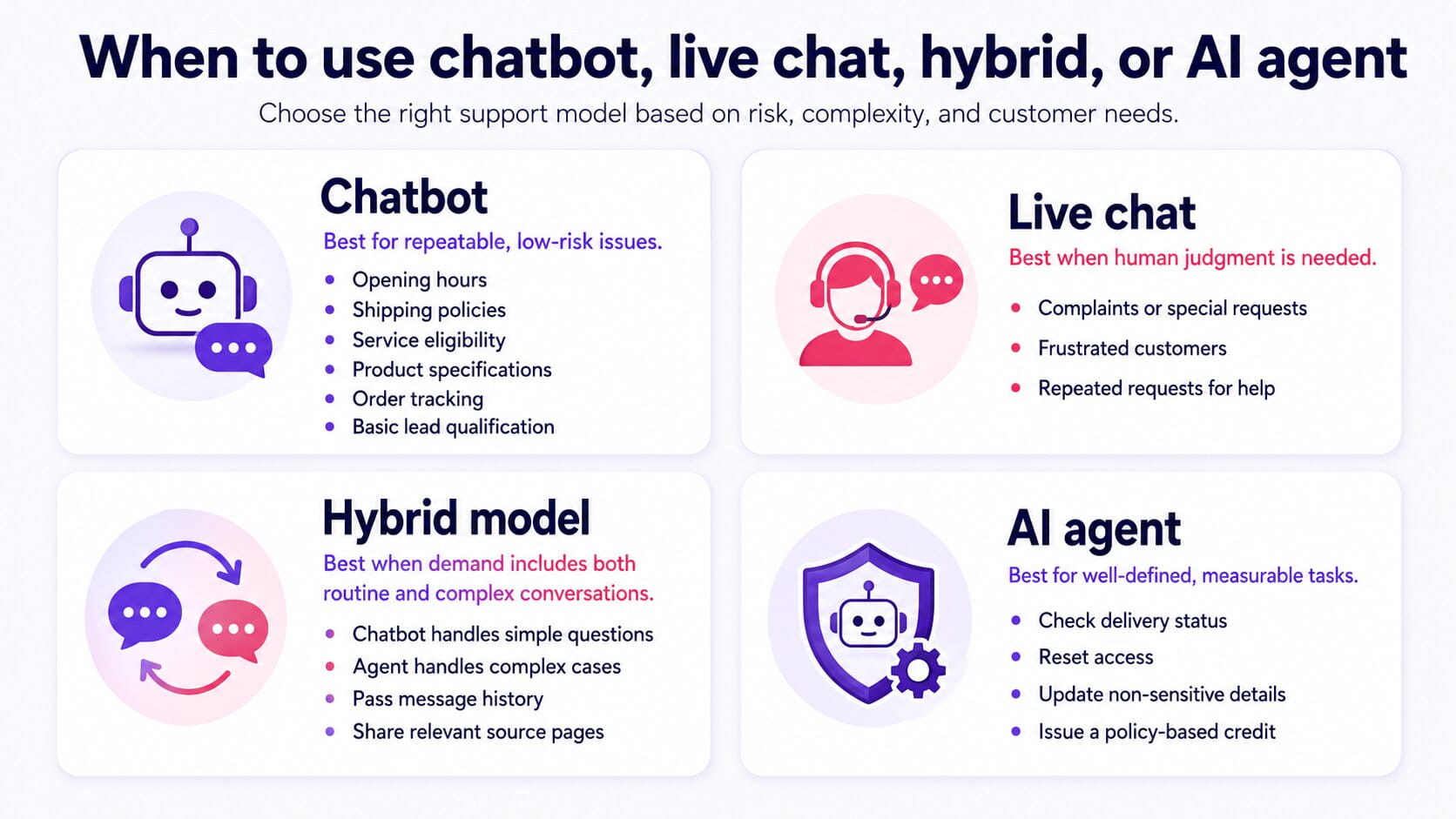
Remember not to begin with broad autonomy over refunds, cancellations, complaints, or regulated decisions without clear controls and human review.
Cost comparison
A basic chatbot can have low software costs, but it still needs content ownership, workflow design, maintenance, and escalation rules.
Meanwhile, a live-chat team has higher direct staffing costs, however, it can protect revenue and customer trust where automated service would fail.
AI-agent pricing is increasingly outcome-based.
Intercom publicly lists Fin at $0.99 per outcome, while Zendesk lists AI-agent pricing from $1.50 per automated resolution. Those figures haven’t included every cost around quality assurance and human escalation.
A misunderstanding that most companies usually have is to assume AI will always remain dramatically cheaper than human support.
Gartner predicts that by 2030, GenAI cost per resolution could exceed $3 and become higher than many B2C offshore human-agent costs, partly because more complex tasks require more data, tokens, and technical support.
The better decision metric now is cost per successful resolution.
How to choose the right model for your business
We always advise our clients to start with their actual conversations. Most of the time, it will begin with reviewing support tickets, sales-chat logs, website search queries, help-centre gaps, customer complaints, and the point where visitors abandon a process.
Then group requests into three categories:
- Safe to automate: repetitive, low-risk, easy to verify.
- Safe to assist: a human should decide, but AI can summarise, retrieve, draft, or translate.
- Human-led: emotionally sensitive, high-value, regulated, ambiguous, or exception-heavy.
A strong implementation also needs a clear owner for quality, experience, and performance measurement. A chatbot shouldn’t become a separate widget that marketing installs while other teams inherit the consequences.
Frequently asked questions (FAQs)
Is a chatbot better than live chat?
A chatbot is better for repeatable questions that need fast, 24/7 answers. Live chat is better for sensitive, complex, high-value, or unclear situations. Most businesses benefit from a hybrid model where AI resolves routine requests and hands difficult conversations to a human agent with context.
Can chatbots replace live agents?
Chatbots can reduce the number of repetitive conversations handled by live agents, but they should not replace humans in every situation. People remain important for complaints, exceptions, negotiations, emotionally sensitive issues, high-value sales, and decisions that require discretion or accountability.
Are chatbots cheaper than live chat?
Chatbots can reduce the cost of routine support at scale, especially when they resolve common questions without human involvement. However, businesses should include setup, integrations, knowledge maintenance, monitoring, failed answers, and escalation costs. The useful metric is cost per successful resolution, not the software subscription alone.
Should I tell customers they are talking to a bot?
Yes. Clear disclosure supports trust and is increasingly a compliance expectation. State that the customer is interacting with an AI assistant, explain what it can do, and show how to reach a person. Do not design the chatbot to impersonate a human employee.
What is a hybrid chatbot?
A hybrid chatbot combines AI automation and human live chat. The AI handles routine questions, gathers context, and recommends next steps. When the issue is complex or sensitive, it transfers the customer to a human agent with the conversation history and relevant information already available.
Do customers prefer humans or chatbots?
Customers usually prefer the fastest path to a correct solution. They may value a chatbot for instant, simple answers and prefer a human when the issue is unclear, emotional, or high-risk. The best experience gives customers both options without forcing them through an unhelpful automated loop.
Conclusion
A chatbot is usually better for predictable requests that need instant answers at any hour. Live chat is better when a customer needs someone accountable for the decision.
However, chatbot vs live chat now hides a more useful question – where should AI sit in the customer journey?
For most service teams, a hybrid model creates the best balance. It gives customers fast self-service for simple issues without trapping them in an automated conversation when the issue becomes complex.
Read more
Tell us about your business challenge and get a tailored consultation today.